I thought I would just put in a short note on the criminal tribunal that we visited before we left Arusha for those who were curious...
We did make it in to the ICTR that Monday. We never did get 'pre-approved' to visit with the form we filled out, but they just took our passports and had us sign in. There was only one trial going on that day, and it was the first day of the trial. We were not allowed to take any photos, but it is all probably best described in words anyway.
The public is allowed to view from a soundproof room at the back of the courtroom. Everyone is given headsets, including the people in the courtroom (lawyers, judges, accused, etc). That way, you automatically get it translated into the appropriate language. The courtroom itself was really not what I expected for an international court. It was nothing fancy, more or less a large room inside a large building. The room was very narrow. There was really nothing remarkable about it. The judges and lawyers wore robes, and everyone else was in business clothes, sipping coffee, etc. It was all very low key.
Since it was the first day of the trial, the defense was supposed to give their opening statement. However, the lead defense attorney (from Canada) was really, for lack of a better word, annoying. She first refused to let the trial begin because she claimed 2 of their witnesses had been called last week by the Rwandan government. The witnesses are supposed to be protected, and therefore that should apparently not have happened. She claimed that it meant that all her witnesses were compromised. She argued (quite disrespectfully in my opinion) with the judges over this and would not let this point go. When they moved on, the judge pointed out that she had 19 witnesses, and was told previously that she could only have 10. Again, the lawyer through a fit saying she could not ably defend the accused man without all 19 witnesses. After much arguing and eye rolling, the judge adjourned for the next two days and said everyone should come back then, prepared. All in all, we were there for about an hour.
We were still glad that we saw the ICTR, even if it was for such a short time. However, we were not willing to wait around again until Wednesday to hear the Canadian lawyer stall some more. So, we decided it was time to press on.
Monday, March 23, 2009


Sunday, March 8, 2009
Arusha, Tanzania
Hello again friends and family!
We have spent almost a week in Arusha, and although we were still here, I thought I would write a blog post about it since I always seem to get a lot of positive response when I post :-)
Arusha is one of the largest and wealthiest cities in Tanzania. Its on the northern side of the country, near the Kenyan border. Its about an hour or two drive from Mount Kilimanjaro, and tends to be the starting point for many safaris to all of the famous national parks. Like Lushoto, it has a pretty high elevation, which means that it stays relatively cool here. Considering how close we are to the equator, I am still amazed that we don't need air conditioning or even a fan to stay comfortable in our room.
Besides the safaris and mountains, Lushoto has a political draw for this part of Africa. They seem to hold a number of international conferences and courts here- there is an East African Human Rights Court currently in session here. The International Criminal Tribunal on Rwanda is also located in Arusha. That means that people charged with committing war crimes in the 1994 genocide in Rwanda are tried here. As we are planning to go to Rwanda next month, we thought it would be interesting to sit in on some proceedings. It seemed like a good educational experience. The Lonely Planet (guidebook) made it sound like you could just show up and watch. We found out that is not so, but with some help from a few very friendly U.N. staff members, we figured out what we have to do to get in, and we are going to try again this week. (It turned out that their computer system was down last week and everything was held off until further notice).
Anyways, since this is the safari capital of Tanzania, we thought we would look into going to the Ngorongoro Crater or the Serengeti. However, we were disappointed to find out that the government has made the entrance fees and vehicle permits astronomical, so we decided not to go. To go to either of those, it looked like it would cost a minimum of $300 per person per day with a tour company. That is much more than our backpackers budget can handle if we still want to see much more of Africa!
So, we decided to do some more cultural tourism like we did in Lushoto. This time, we took a trip to the small village of Ngirisi just outside of Arusha. Its up in the hills, and while there we got to take walks through the farms, learn about the different crops and trees, and learn about local life. We learned a little about their home life by going into a villagers home. Apparently they think that cows do so much for them, like provide milk, meat, and consequently money and well being, that they allow the cows to sleep inside. Not in a barn, but in their house. The traditional house is packed mud and bricks. No electricity or water. No beds. No walls, just partitions made of sticks. The cows sleep in one partition. The man of the house sleeps by the door (like a guard), the mother and girls sleep in another partitioned area, and the boys sleep where they can, most likely by the cooking fire in the center of the house.
 The fire for cooking inside the house.
 The woman of the house displaying her large gourd she uses as a container.
It was very interesting to learn about. We also saw the outside of their schools and went to their 'holy tree'- a great big tree in the shape of Africa. It was pretty cool.
 The Africa tree.
Another little trip we did was a canoe trip on a lake nearby. It was an average sized lake, but seemed to be on a reserve. There was absolutely no one else on the lake, so it was quite peaceful, and we paddled around for a few hours.
 Andrej enjoying the canoe.
 Andrej was fascinated by the papyrus.
We saw lots or unique birds and some really large lizards on the banks.


After canoeing, a guide took us on a walk to the village market. On the way, we learned a lot about different types of medicinal plants and what they are used for, as well as everything you could ever want to know about bananas. The market we went to was huge and bustling. People were selling fresh fruits, vegetables, spices, etc. It was like a gigantic farmers market, and organic food lovers dream. There is certainly no shortage of food in this part of Africa. In fact, I don't think I have ever seen that many fruits in vegetables in my life.
One other little interesting note- our hotel in Arusha is in an area of town that seems to have all the mosques. There appears to be 2 on either side of our hotel, and you can hear them broadcasting their call to worship (often simultaneously) on their loudspeakers. I have no idea what they are singing, but I still think it is a really neat sound, and I actually like listening to it most of the time. In the quiet of the pre-dawn hours (5 am) they wake me up every morning. However, it seems that the one at 5am is always haunting and beautiful, and I find that I don't really mind that it wakes me up. I fall back asleep soon again anyways. Today was Sunday, and around 7am, the noise became mingled with church bells, and it was fun to listen to.
Other than that, we have been enjoying city life in Arusha- going to movies, eating good food, using the internet, and planning our further adventures. This week we are planning to press on to Uganda. Uganda sounds like a fun and beautiful place. We are also hoping to put ourselves to work- it looks like we will be volunteering and building a classroom block at a school for orphans and underprivileged children at a school run by a Rotarian from Uganda who came to speak at one of my Rotaract meetings last year. We are looking forward to a change of pace and to meeting a lot of new people!
Bye for now!
We have spent almost a week in Arusha, and although we were still here, I thought I would write a blog post about it since I always seem to get a lot of positive response when I post :-)
Arusha is one of the largest and wealthiest cities in Tanzania. Its on the northern side of the country, near the Kenyan border. Its about an hour or two drive from Mount Kilimanjaro, and tends to be the starting point for many safaris to all of the famous national parks. Like Lushoto, it has a pretty high elevation, which means that it stays relatively cool here. Considering how close we are to the equator, I am still amazed that we don't need air conditioning or even a fan to stay comfortable in our room.
Besides the safaris and mountains, Lushoto has a political draw for this part of Africa. They seem to hold a number of international conferences and courts here- there is an East African Human Rights Court currently in session here. The International Criminal Tribunal on Rwanda is also located in Arusha. That means that people charged with committing war crimes in the 1994 genocide in Rwanda are tried here. As we are planning to go to Rwanda next month, we thought it would be interesting to sit in on some proceedings. It seemed like a good educational experience. The Lonely Planet (guidebook) made it sound like you could just show up and watch. We found out that is not so, but with some help from a few very friendly U.N. staff members, we figured out what we have to do to get in, and we are going to try again this week. (It turned out that their computer system was down last week and everything was held off until further notice).
Anyways, since this is the safari capital of Tanzania, we thought we would look into going to the Ngorongoro Crater or the Serengeti. However, we were disappointed to find out that the government has made the entrance fees and vehicle permits astronomical, so we decided not to go. To go to either of those, it looked like it would cost a minimum of $300 per person per day with a tour company. That is much more than our backpackers budget can handle if we still want to see much more of Africa!
So, we decided to do some more cultural tourism like we did in Lushoto. This time, we took a trip to the small village of Ngirisi just outside of Arusha. Its up in the hills, and while there we got to take walks through the farms, learn about the different crops and trees, and learn about local life. We learned a little about their home life by going into a villagers home. Apparently they think that cows do so much for them, like provide milk, meat, and consequently money and well being, that they allow the cows to sleep inside. Not in a barn, but in their house. The traditional house is packed mud and bricks. No electricity or water. No beds. No walls, just partitions made of sticks. The cows sleep in one partition. The man of the house sleeps by the door (like a guard), the mother and girls sleep in another partitioned area, and the boys sleep where they can, most likely by the cooking fire in the center of the house.
 The fire for cooking inside the house.
 The woman of the house displaying her large gourd she uses as a container.
It was very interesting to learn about. We also saw the outside of their schools and went to their 'holy tree'- a great big tree in the shape of Africa. It was pretty cool.
 The Africa tree.
Another little trip we did was a canoe trip on a lake nearby. It was an average sized lake, but seemed to be on a reserve. There was absolutely no one else on the lake, so it was quite peaceful, and we paddled around for a few hours.
 Andrej enjoying the canoe.
 Andrej was fascinated by the papyrus.
We saw lots or unique birds and some really large lizards on the banks.


After canoeing, a guide took us on a walk to the village market. On the way, we learned a lot about different types of medicinal plants and what they are used for, as well as everything you could ever want to know about bananas. The market we went to was huge and bustling. People were selling fresh fruits, vegetables, spices, etc. It was like a gigantic farmers market, and organic food lovers dream. There is certainly no shortage of food in this part of Africa. In fact, I don't think I have ever seen that many fruits in vegetables in my life.
One other little interesting note- our hotel in Arusha is in an area of town that seems to have all the mosques. There appears to be 2 on either side of our hotel, and you can hear them broadcasting their call to worship (often simultaneously) on their loudspeakers. I have no idea what they are singing, but I still think it is a really neat sound, and I actually like listening to it most of the time. In the quiet of the pre-dawn hours (5 am) they wake me up every morning. However, it seems that the one at 5am is always haunting and beautiful, and I find that I don't really mind that it wakes me up. I fall back asleep soon again anyways. Today was Sunday, and around 7am, the noise became mingled with church bells, and it was fun to listen to.
Other than that, we have been enjoying city life in Arusha- going to movies, eating good food, using the internet, and planning our further adventures. This week we are planning to press on to Uganda. Uganda sounds like a fun and beautiful place. We are also hoping to put ourselves to work- it looks like we will be volunteering and building a classroom block at a school for orphans and underprivileged children at a school run by a Rotarian from Uganda who came to speak at one of my Rotaract meetings last year. We are looking forward to a change of pace and to meeting a lot of new people!
Bye for now!
Thursday, March 5, 2009
Lushoto, Tanzania
Back on the mainland! After we left Zanzibar, we headed back to Dar es Salaam for a day, then took a bus up to the mountains in Northern Tanzania. We ended up in a small town called Lushoto, in the Usambara mountain range.
We had read that there was a lot of good hiking in the Lushoto area, and that's why we went there. Thanks to being in the mountains, Lushoto enjoys a quite cool climate despite it's proximity to the equator. That makes it much more pleasant to be outside all day, and with the mountains, there are numerous winding footpaths between the villages.
Our first day there, we signed up for a one day guided hike to a rainforest, farm, and lookout point for the next day. I requested a woman guide, as I felt like so many of the people we meet in the tourism industry here (and especially the street touts) seem to be men. So, I thought this would be a good opportunity to speak to a local woman and ask a lot of questions about life in the area. There was one woman guide available, and she turned out to be absolutely fantastic. She was very talkative, honest, and intelligent. The tourism office was sending her to university to get a degree in business so they could make their office locally sustainable (it had started with the help of a Dutch NGO). And the best part is, the tourism office is non-profit and donates all of their proceeds back to the community. So anyways, we were very happy with the whole situation. The hike started off very nice. It winded through green mountain hills and we encountered lots of locals going about their day and even the occasional monkey. The forest held a lot of dense vegetation and involved a somewhat more intense uphill hike.
 Andrej in the forest.
We made it to the top around noon and we were both very tired. We rested there for a while and got the chance to enjoy a great view of all the surrounding mountains.
 A view from the top.
 Andrej and our guide, Mwisho going down the mountain.
We continued on to the farm (followed by school kids most of the way) where we had a wonderful organic lunch. However, we were very tired and ended up going back to our hotel after lunch.
The rest of the week in Lushoto was very low key. We enjoyed staying in a nice, lodge style hotel because it was the low season and we could get a very cheap room there. We even had our own fireplace! A lot of time was spent reading, wandering around the market in town, and exploring the mountain paths on our own.
 One of the paths I found.
 A view of the town.
We also enjoyed some very cheap local meals. My favorite was the pilau. A staple here is called ugali. Its a rather tasteless food, which I believe to be pounded and moist white rice in a giant ball. You eat it with a sauce or veggies. Andrej ordered it one night- it was alright, but not our favorite.
We went on one more tour while in town, this time by car. We went to a nearby waterfall and this time made it to the view point near the farm. The view point had magnificent views from the edge of the mountain range looking over cliffs and the plains below.
 Us at the waterfall.
 At the viewpoint looking over the cliffs and plains below.
After a week there, we got on the bus again and headed to Arusha, the largest city in Northern Tanzania. More to come soon on Arusha!
We had read that there was a lot of good hiking in the Lushoto area, and that's why we went there. Thanks to being in the mountains, Lushoto enjoys a quite cool climate despite it's proximity to the equator. That makes it much more pleasant to be outside all day, and with the mountains, there are numerous winding footpaths between the villages.
Our first day there, we signed up for a one day guided hike to a rainforest, farm, and lookout point for the next day. I requested a woman guide, as I felt like so many of the people we meet in the tourism industry here (and especially the street touts) seem to be men. So, I thought this would be a good opportunity to speak to a local woman and ask a lot of questions about life in the area. There was one woman guide available, and she turned out to be absolutely fantastic. She was very talkative, honest, and intelligent. The tourism office was sending her to university to get a degree in business so they could make their office locally sustainable (it had started with the help of a Dutch NGO). And the best part is, the tourism office is non-profit and donates all of their proceeds back to the community. So anyways, we were very happy with the whole situation. The hike started off very nice. It winded through green mountain hills and we encountered lots of locals going about their day and even the occasional monkey. The forest held a lot of dense vegetation and involved a somewhat more intense uphill hike.
 Andrej in the forest.
We made it to the top around noon and we were both very tired. We rested there for a while and got the chance to enjoy a great view of all the surrounding mountains.
 A view from the top.
 Andrej and our guide, Mwisho going down the mountain.
We continued on to the farm (followed by school kids most of the way) where we had a wonderful organic lunch. However, we were very tired and ended up going back to our hotel after lunch.
The rest of the week in Lushoto was very low key. We enjoyed staying in a nice, lodge style hotel because it was the low season and we could get a very cheap room there. We even had our own fireplace! A lot of time was spent reading, wandering around the market in town, and exploring the mountain paths on our own.
 One of the paths I found.
 A view of the town.
We also enjoyed some very cheap local meals. My favorite was the pilau. A staple here is called ugali. Its a rather tasteless food, which I believe to be pounded and moist white rice in a giant ball. You eat it with a sauce or veggies. Andrej ordered it one night- it was alright, but not our favorite.
We went on one more tour while in town, this time by car. We went to a nearby waterfall and this time made it to the view point near the farm. The view point had magnificent views from the edge of the mountain range looking over cliffs and the plains below.
 Us at the waterfall.
 At the viewpoint looking over the cliffs and plains below.
After a week there, we got on the bus again and headed to Arusha, the largest city in Northern Tanzania. More to come soon on Arusha!
Sunday, February 22, 2009
More pictures...
I uploaded some pictures to my flickr site: www.flickr.com/photos/piratejill . Feel free to check them out if you would like to see a few more photos of our travels!
Saturday, February 21, 2009
Zanzibar
Note: Check our old posts for more new pictures!
After flying out of Mozambique, we made a fairly uneventful arrival in Dar Es Salaam, Tanzania. Dar is about halfway up the east coast of Tanzania and is quite a large city. Swahili and English are spoken here (yay for English!). We spent a couple nights here, enjoying being in a city. We were able to buy a couple guidebooks for this part of Africa, use the internet, and do a little shopping. However, the best was yet to come.
I have always wanted to go to Zanzibar ever since I first heard about it a number of years ago. Not only does it have an awesome name that sounds like it should be an island on Mars, but it is known for its beaches and scenery. Oh yeah, and its cool history as well.
We took a ferry out to Zanzibar. It took about 2 hours and was rather nice as ferries go. We arrived in a bustling town in the rain to discover that there was a large music festival going on that week and all the hotels were booked. Bummer. After having our taxi driver drive us around in the rain for a while, we found a hotel with a room, where we stayed for 3 nights.
Zanzibar town is famous for its Stone Town. Right in the port area, is a town made mostly of a bunch of old, stone buildings. Its composed of tiny, winding roads with little side alleys. Its really enchanting. The population of the town is primarily Muslim, and you look down any little alley and you see women in their long, flowing black robes and black head scarves (and sometimes face covers so all you see is their eyes) and men in their long white robes and white, circular hats. It all feels very foreign and mysterious. Every once in a while you hear the Muslim call to prayer wafting from a mosque and see the men walking in, leaving a pile of sandals outside the mosque.
The interesting part of Zanzibar's history is that for centuries, it was ruled by Oman. With sultans and palaces and everything. It is independent now and a part of Tanzania. However, you can tour the museums and palaces and ruins of the bath houses, and gaze at the architecture, and really get a feel for the history of the place.
Anyways, on to what we actually did in Zanzibar...
We walked around the little winding roads. We went to the music festival where we saw groups from reggae artists from Ethiopia to classical artists to pop artists from Kenya. We ate tasty food. We toured the old palaces and museums. We rented a moped and cruised around outside of town to sites of old ruins. That leads me to our first story.
Stone Town is a busy place. Lots of cars, mopeds, pedestrians, bicycles, daladalas (the Zanzibar version of the death cab). Oh, and they drive on the left. After realizing how hectic it was, we decided that Andrej would do all the driving, as he has a little motorcycle experience and I have none. Anyways, we did pretty well and made it out of town. We were driving along on a beautiful, palm tree lined dirt road going to some caves. We hit a rock with our muffler and tipped over into a puddle (luckily we were already going very slow and we more or less stepped off the moped). Soon, some other people came by on mopeds or bikes or cars or even just strolling along. Within minutes we had about 10 people helping us. Everyone who stopped to help us helped us like we were their best friends, not complete strangers who can't speak Swahili. They helped us without even asking if we needed help. They stopped what they were doing and put off where they were going to help. The got out tools, removed the tire, hammered the exhaust pipe. As it turned out, the rock had jammed the pipe into our back tire. Anyways, with the help of all those nice men, we were back on the road in half an hour. After it was fixed, everyone dispersed as quickly as they came and all we could do was shout our thanks.
Another story to display the friendliness of the people of Zanzibar happened just a couple hours later. We were on another rural road and it started to rain pretty hard, so we pulled over under a large tree for some shelter. A girl in the house across the road saw us and insisted we come in her house to wait out the rain. So we did. We sat on their floor (they didn't have furniture) quietely (we need to learn more Swahili) and everyone smiled at each other as we waited a few minutes for the rain to let up. When it did, the kids walked us out to our moped and waved as we drove off.
This place is very refreshing. There are a lot of tourists around here, but everyone still smiles and makes a point to say jambo! (hello!) to you whenever they see you.
The day after we rented our moped, we took a daladala out to Bwejuu, a small village on the east coast of Zanzibar. The destination was the beach, and the beach we got. We stayed at a fabulous little place called The Twisted Palms. It was right on the beach, and run by an Italian couple. It had a restaurant, and as Italians are very picky about their food, we ate VERY well the whole time we were there. The breakfasts were large and free with fresh fruit and juice. We had a nice little basic bungalow up on the hill above the beach. We had a fabulous time out there. We rented bikes and road up and down the beach. We rented a car and drove out to the Jozani Forest, where we saw the apparently rare red colobus monkeys. We drove out to a butterfly garden, and we drove all along the coast. All that was great, but my absolute favorite thing was the catamaran. We rented the catamaran one sunny morning. I had never been on one before, and Andrej had only been on one once or twice. However, we quickly got the hang of it and had 3 very enjoyable hours sailing around in the ocean around Zanzibar. A catamaran is made of two small pontoons with a tarp between them, a mainsail, a foresail, and a couple rudders. It was quite simple, and it could really cruise. The water of the Indian Ocean is really warm and it made for a very pleasant ride. We also spent one more day just being lazy beach bums before coming back to Stone Town. I think I will always remember my time on Zanzibar as one of my favorites of this whole trip. Bwejuu was my favorite place we have been so far.
We are back in Stone Town now, and real life calls. We caved and bought a cell phone today. I have spent hours here at this internet cafe attempting to file my taxes. And tomorrow we head back to the mainland for more adventures in Tanzania. Until then....
Here are some photos from Zanzibar:
 The catamaran we sailed around in.
 Andrej in the Jozani Forest with some large cactus.
 Andrej and me during a walk on the beach.
 Andrej on his bike during our bike ride down the beach to the next town, Paje.
 A boat we saw pass by from our breakfast table one morning.
 Andrej and me riding our moped. Still alive and happy even after falling off!
 Andrej on the moped on one of the rural roads in Zanzibar.
 Andrej exploring the ruins outside of town.
 The reggae group from Ethiopia at the music festival. The festival was held in an old fort.
 Me on the terrace overlooking the ocean at one of the palace museums.
After flying out of Mozambique, we made a fairly uneventful arrival in Dar Es Salaam, Tanzania. Dar is about halfway up the east coast of Tanzania and is quite a large city. Swahili and English are spoken here (yay for English!). We spent a couple nights here, enjoying being in a city. We were able to buy a couple guidebooks for this part of Africa, use the internet, and do a little shopping. However, the best was yet to come.
I have always wanted to go to Zanzibar ever since I first heard about it a number of years ago. Not only does it have an awesome name that sounds like it should be an island on Mars, but it is known for its beaches and scenery. Oh yeah, and its cool history as well.
We took a ferry out to Zanzibar. It took about 2 hours and was rather nice as ferries go. We arrived in a bustling town in the rain to discover that there was a large music festival going on that week and all the hotels were booked. Bummer. After having our taxi driver drive us around in the rain for a while, we found a hotel with a room, where we stayed for 3 nights.
Zanzibar town is famous for its Stone Town. Right in the port area, is a town made mostly of a bunch of old, stone buildings. Its composed of tiny, winding roads with little side alleys. Its really enchanting. The population of the town is primarily Muslim, and you look down any little alley and you see women in their long, flowing black robes and black head scarves (and sometimes face covers so all you see is their eyes) and men in their long white robes and white, circular hats. It all feels very foreign and mysterious. Every once in a while you hear the Muslim call to prayer wafting from a mosque and see the men walking in, leaving a pile of sandals outside the mosque.
The interesting part of Zanzibar's history is that for centuries, it was ruled by Oman. With sultans and palaces and everything. It is independent now and a part of Tanzania. However, you can tour the museums and palaces and ruins of the bath houses, and gaze at the architecture, and really get a feel for the history of the place.
Anyways, on to what we actually did in Zanzibar...
We walked around the little winding roads. We went to the music festival where we saw groups from reggae artists from Ethiopia to classical artists to pop artists from Kenya. We ate tasty food. We toured the old palaces and museums. We rented a moped and cruised around outside of town to sites of old ruins. That leads me to our first story.
Stone Town is a busy place. Lots of cars, mopeds, pedestrians, bicycles, daladalas (the Zanzibar version of the death cab). Oh, and they drive on the left. After realizing how hectic it was, we decided that Andrej would do all the driving, as he has a little motorcycle experience and I have none. Anyways, we did pretty well and made it out of town. We were driving along on a beautiful, palm tree lined dirt road going to some caves. We hit a rock with our muffler and tipped over into a puddle (luckily we were already going very slow and we more or less stepped off the moped). Soon, some other people came by on mopeds or bikes or cars or even just strolling along. Within minutes we had about 10 people helping us. Everyone who stopped to help us helped us like we were their best friends, not complete strangers who can't speak Swahili. They helped us without even asking if we needed help. They stopped what they were doing and put off where they were going to help. The got out tools, removed the tire, hammered the exhaust pipe. As it turned out, the rock had jammed the pipe into our back tire. Anyways, with the help of all those nice men, we were back on the road in half an hour. After it was fixed, everyone dispersed as quickly as they came and all we could do was shout our thanks.
Another story to display the friendliness of the people of Zanzibar happened just a couple hours later. We were on another rural road and it started to rain pretty hard, so we pulled over under a large tree for some shelter. A girl in the house across the road saw us and insisted we come in her house to wait out the rain. So we did. We sat on their floor (they didn't have furniture) quietely (we need to learn more Swahili) and everyone smiled at each other as we waited a few minutes for the rain to let up. When it did, the kids walked us out to our moped and waved as we drove off.
This place is very refreshing. There are a lot of tourists around here, but everyone still smiles and makes a point to say jambo! (hello!) to you whenever they see you.
The day after we rented our moped, we took a daladala out to Bwejuu, a small village on the east coast of Zanzibar. The destination was the beach, and the beach we got. We stayed at a fabulous little place called The Twisted Palms. It was right on the beach, and run by an Italian couple. It had a restaurant, and as Italians are very picky about their food, we ate VERY well the whole time we were there. The breakfasts were large and free with fresh fruit and juice. We had a nice little basic bungalow up on the hill above the beach. We had a fabulous time out there. We rented bikes and road up and down the beach. We rented a car and drove out to the Jozani Forest, where we saw the apparently rare red colobus monkeys. We drove out to a butterfly garden, and we drove all along the coast. All that was great, but my absolute favorite thing was the catamaran. We rented the catamaran one sunny morning. I had never been on one before, and Andrej had only been on one once or twice. However, we quickly got the hang of it and had 3 very enjoyable hours sailing around in the ocean around Zanzibar. A catamaran is made of two small pontoons with a tarp between them, a mainsail, a foresail, and a couple rudders. It was quite simple, and it could really cruise. The water of the Indian Ocean is really warm and it made for a very pleasant ride. We also spent one more day just being lazy beach bums before coming back to Stone Town. I think I will always remember my time on Zanzibar as one of my favorites of this whole trip. Bwejuu was my favorite place we have been so far.
We are back in Stone Town now, and real life calls. We caved and bought a cell phone today. I have spent hours here at this internet cafe attempting to file my taxes. And tomorrow we head back to the mainland for more adventures in Tanzania. Until then....
Here are some photos from Zanzibar:
 The catamaran we sailed around in.
 Andrej in the Jozani Forest with some large cactus.
 Andrej and me during a walk on the beach.
 Andrej on his bike during our bike ride down the beach to the next town, Paje.
 A boat we saw pass by from our breakfast table one morning.
 Andrej and me riding our moped. Still alive and happy even after falling off!
 Andrej on the moped on one of the rural roads in Zanzibar.
 Andrej exploring the ruins outside of town.
  The reggae group from Ethiopia at the music festival. The festival was held in an old fort.
 Me on the terrace overlooking the ocean at one of the palace museums.
Pemba, Mozambique
Wow, we are way behind on blog posts! A lot has happened since Ilha de Mocambique!
After the island, we spent one day in transit in Nacala, Mozambique, then hopped our 4 am bus to Pemba, Mozambique further up the coast. We spent 5 days here just outside of town on Wimbi Beach.
There is not a whole lot to tell about Pemba. It seemed to be the start of the rainy season, so it rained usually once a day. That was nice however, as it seemed to cool things off. A couple times we made the long trek into town to go to the bakery, supermarket, internet cafe, restaurants, or to buy a plane ticket. The rest of the time we spent around the beach area, just walking around or hanging out at the nice beach front restaurants. All in all, it was a more relaxing experience.
Travel in Mozambique was difficult, as I outlined in my last post, and not being able to communicate made things a little tough. So in the end, we decided to fly from Pemba all the way to Dar Es Salaam, Tanzania. The other way to cross the border into Tanzania appeared to involved multiple days (with pre-dawn starts no doubt) and a dug out canoe river crossing at the border, as well as many more death cabs. It seemed adventurous, yet... we were ready to move on.
Pemba is best described in pictures, so I will leave you with some pictures of our last Mozambique destination:
 Andrej took this picture of what we think is the mail delivery bike outside the Pemba post office.
 Andrej at Wimbi Beach.
 Ocean view at Pemba.
 Sunset over Wimbi Beach.
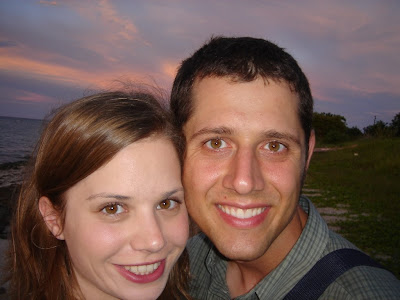 Jill and Andrej.
 Andrej relaxing at our favorite beachside restaurant, the Pemba Dolphin.
After the island, we spent one day in transit in Nacala, Mozambique, then hopped our 4 am bus to Pemba, Mozambique further up the coast. We spent 5 days here just outside of town on Wimbi Beach.
There is not a whole lot to tell about Pemba. It seemed to be the start of the rainy season, so it rained usually once a day. That was nice however, as it seemed to cool things off. A couple times we made the long trek into town to go to the bakery, supermarket, internet cafe, restaurants, or to buy a plane ticket. The rest of the time we spent around the beach area, just walking around or hanging out at the nice beach front restaurants. All in all, it was a more relaxing experience.
Travel in Mozambique was difficult, as I outlined in my last post, and not being able to communicate made things a little tough. So in the end, we decided to fly from Pemba all the way to Dar Es Salaam, Tanzania. The other way to cross the border into Tanzania appeared to involved multiple days (with pre-dawn starts no doubt) and a dug out canoe river crossing at the border, as well as many more death cabs. It seemed adventurous, yet... we were ready to move on.
Pemba is best described in pictures, so I will leave you with some pictures of our last Mozambique destination:
 Andrej took this picture of what we think is the mail delivery bike outside the Pemba post office.
 Andrej at Wimbi Beach.
 Ocean view at Pemba.
 Sunset over Wimbi Beach.
 Jill and Andrej.
 Andrej relaxing at our favorite beachside restaurant, the Pemba Dolphin.
Thursday, February 5, 2009
Ilha de Moçambique
After Kruger Park, we made our way to Mozambique. We took a bus across the border to Maputo, the capital of Mozambique. We decided that since Mozambique is such a large country that we would try to fly across much of it to save a lot of time on buses. We had spent quite a lot of time the days beforehand trying to call the airline, but could not get through to anyone. So, we just showed up at the airport about 6:30am and they booked us on a flight to Nampula that left at 7:30am. Sweet! That worked out surprisngly well. The plane stopped at one other town on the way and we made it safely to Nampula, where we took a taxi to the mini-bus stand.
Unfortunetly, it seems that the only way to get to non-major cities in Mozambique is to take the death cabs. This one was actually a mini-bus, which seemed a little better than a big van, but no. They still packed in about 30 people to a bus that would comfortably seat about 15 or so. People were on each others laps, men were standing hanging out the side door or leaning over the seated people. And it was HOT. Its a very unpleasant way to get around, yet so many people use it as it is pretty much the only way to get around. When you stop somewhere, people swarm the car and try to sell you things. Anything from flashlights to eggs to live chickens. Who would buy a live chicken then put it in a packed van of people where there is barely room to breathe??? Apparently someone buys it, otherwise they wouldn´t sell it. Luckily no one in our van bought one...
 On our chapa (death cab). Men standing in the aisles and leaning over people in the seats. You can't see the ones hanging out the door...
Our goal was to get to Ilha de Moçambique (Mozambique Island). To get there, you have to cross a small 3.5 km bridge. Due to weight restrictions, our van couldn´t go over. So they made us get in the back of a pick-up to go to the island itself from the town on the coast. Us and about 15 other people and luggage and cargo.
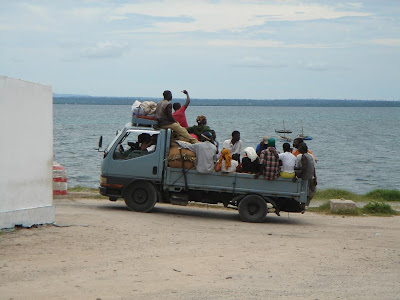 Not our pick-up, but this is like what we rode to get across the bridge.
Once there, we managed to find a hotel. The next day was a national holiday and most things were closed, so we layed low for a while.
Mozambique was colonized by the Portuguese. If I have my facts right, Mozambique Island was where Vasco de Gama first landed and the Portuguese set it up as a trading center back in the 1500s. The place has a lot of history- lots of old Portuguese style stone buildings that you would find in an important port and trading town. Lots of churches and mosques and forts. All surrounded by beautiful blue water. All this and judging by the way the guide books talk it up, it seems like a perfect tourist destination.
It is a neat place, but not quite what we were expecting. The main fort was closed, the beach was covered in trash, most of the buildings have not been kept up. On the holiday when everything was closed, it really looked like a ghost town. It really is too bad, because if they made it easier to get to, put some signposts up so you knew what things were, and kept up the buildings nicely, it would be a huge hit with tourists.
 An old church on the edge of the island.
 A pretty, but dirty beach.
 Some interesting architecture.
 A charming side street.
We did get some good exploring in. Checked out a museum of the governer´s mansion and some church artifacts. We walked around the island looking at the old buildings and checking out the market and the beaches. Kids followed us around the entire time. Sometimes they were helpful and even cute, but after a few hours, it would be nice to not have someone one step behind you for every move you make. But I have the feeling that this will be the rule rather than the exception for a lot of our time here. When we were having dinner at a restaurant, we were sitting at a streetside table. A group of young girls surrounded us. We smiled and acknowledged them, but that wasn´t enough. They also pounded on our table and poked at me. After telling them goodbye and waving multiple times, they still wouldn´t relent. When they stood inches away pointing and laughing at me while I ate, that was the last straw and we ended up going inside. I don´t think it is a good tourist thing to do to get irate with the kids, and I think its inevitable that they will be curious, but I have been having a hard time contemplating where I should draw the line to keep my own sanity and privacy.
 The 3 boys who followed us around and were our unofficial tour guides for the day.
Other interesting things about Mozambique- they speak Portuguese. Which, of course, makes things much more difficult than they were in South Africa where most everyone spoke English. The simple things are difficult to communicate. Figuring out how to get from point A to B, asking for the bill at a restaurant, chatting with strangers, etc. I asked our hotel manager where I could find a Portuguese- English phrasebook or dictionary. He said his friend had one he could sell me. Turns out it was a used paperback (which would have been great). However he asked me for $18 for it, when the NEW list price was $5.99. I felt that wasn´t a fair price, so instead we just bumble around throwing out Spanish and English and the few words of Portuguese they have in the Lonely Planet.
Another thing, it is REALLY hot here. South Africa was quite temperate and we never had air conditioning and were usually fine. Here, the heat is suffocating. We even tried swimming in the ocean to cool off, but the water was just as warm as the air. It almost felt like a hot tub. Today we have the luxury of an air conditioned hotel room for the first time. Unforuntely you definitely pay for it, so I think we will just have to get used to the heat.
Lastly, the transportation is crazy. Not only do they pack so many people in that it hurts, but they seem to all depart at ungodly hours of the morning. Today, they picked us up from our hotel at 3:50am. As far as we could tell, unless we wanted to ride in the back of a pickup the whole way, that was when we had to go. The girl across from me fell asleep on my leg. Today, to get to Nacala, we had to switch death cabs halfway through. Or so we thought. We got off at the halfway point, looked rather confused, and luckily a man helped us figure out where to get the next death cab. However, instead of a death cab, a flat bed truck pulled up, someone hopped out of the cab and climbed on the back, and Andrej and me and our bags piled into the cab with the driver. So we inadvertantly hitch hiked. I have to say that the cab was extremely comfortable, no whatsoever crowded, and the driver drove slow in safe. It was fabulous. Then we got into town and he dropped us at a taxi queue. We wanted to go about 10 km out of town to a beach hotel we read about in the guidebook. The driver tried to take a back road made of sand and we got hopelessly stuck. It took3 men from passing trucks, the driver, Andrej, me, and a borrowed hoe from a farm lady half an hour to get ourselves out. We took the long way around, only to find out the place is no longer open and go straight back into town. Wow.
So anyways, we decided to go on to another beach town by what seems to be an actual bus tomorrow. What time does the bus leave? 4am of course! What time do you need to get there to get a ticket? 3am! JOY! We are really hoping this is a quirk of Mozambique transportation and that it won´t be like this elsewhere in Africa, but we shall see...
Once again, I am unable to post pictures, but I will get some nice Mozambique photos up as soon as I can. Take care everyone!
Unfortunetly, it seems that the only way to get to non-major cities in Mozambique is to take the death cabs. This one was actually a mini-bus, which seemed a little better than a big van, but no. They still packed in about 30 people to a bus that would comfortably seat about 15 or so. People were on each others laps, men were standing hanging out the side door or leaning over the seated people. And it was HOT. Its a very unpleasant way to get around, yet so many people use it as it is pretty much the only way to get around. When you stop somewhere, people swarm the car and try to sell you things. Anything from flashlights to eggs to live chickens. Who would buy a live chicken then put it in a packed van of people where there is barely room to breathe??? Apparently someone buys it, otherwise they wouldn´t sell it. Luckily no one in our van bought one...
 On our chapa (death cab). Men standing in the aisles and leaning over people in the seats. You can't see the ones hanging out the door...
Our goal was to get to Ilha de Moçambique (Mozambique Island). To get there, you have to cross a small 3.5 km bridge. Due to weight restrictions, our van couldn´t go over. So they made us get in the back of a pick-up to go to the island itself from the town on the coast. Us and about 15 other people and luggage and cargo.
 Not our pick-up, but this is like what we rode to get across the bridge.
Once there, we managed to find a hotel. The next day was a national holiday and most things were closed, so we layed low for a while.
Mozambique was colonized by the Portuguese. If I have my facts right, Mozambique Island was where Vasco de Gama first landed and the Portuguese set it up as a trading center back in the 1500s. The place has a lot of history- lots of old Portuguese style stone buildings that you would find in an important port and trading town. Lots of churches and mosques and forts. All surrounded by beautiful blue water. All this and judging by the way the guide books talk it up, it seems like a perfect tourist destination.
It is a neat place, but not quite what we were expecting. The main fort was closed, the beach was covered in trash, most of the buildings have not been kept up. On the holiday when everything was closed, it really looked like a ghost town. It really is too bad, because if they made it easier to get to, put some signposts up so you knew what things were, and kept up the buildings nicely, it would be a huge hit with tourists.
 An old church on the edge of the island.
 A pretty, but dirty beach.
 Some interesting architecture.
 A charming side street.
We did get some good exploring in. Checked out a museum of the governer´s mansion and some church artifacts. We walked around the island looking at the old buildings and checking out the market and the beaches. Kids followed us around the entire time. Sometimes they were helpful and even cute, but after a few hours, it would be nice to not have someone one step behind you for every move you make. But I have the feeling that this will be the rule rather than the exception for a lot of our time here. When we were having dinner at a restaurant, we were sitting at a streetside table. A group of young girls surrounded us. We smiled and acknowledged them, but that wasn´t enough. They also pounded on our table and poked at me. After telling them goodbye and waving multiple times, they still wouldn´t relent. When they stood inches away pointing and laughing at me while I ate, that was the last straw and we ended up going inside. I don´t think it is a good tourist thing to do to get irate with the kids, and I think its inevitable that they will be curious, but I have been having a hard time contemplating where I should draw the line to keep my own sanity and privacy.
 The 3 boys who followed us around and were our unofficial tour guides for the day.
 Other interesting things about Mozambique- they speak Portuguese. Which, of course, makes things much more difficult than they were in South Africa where most everyone spoke English. The simple things are difficult to communicate. Figuring out how to get from point A to B, asking for the bill at a restaurant, chatting with strangers, etc. I asked our hotel manager where I could find a Portuguese- English phrasebook or dictionary. He said his friend had one he could sell me. Turns out it was a used paperback (which would have been great). However he asked me for $18 for it, when the NEW list price was $5.99. I felt that wasn´t a fair price, so instead we just bumble around throwing out Spanish and English and the few words of Portuguese they have in the Lonely Planet.
Another thing, it is REALLY hot here. South Africa was quite temperate and we never had air conditioning and were usually fine. Here, the heat is suffocating. We even tried swimming in the ocean to cool off, but the water was just as warm as the air. It almost felt like a hot tub. Today we have the luxury of an air conditioned hotel room for the first time. Unforuntely you definitely pay for it, so I think we will just have to get used to the heat.
Lastly, the transportation is crazy. Not only do they pack so many people in that it hurts, but they seem to all depart at ungodly hours of the morning. Today, they picked us up from our hotel at 3:50am. As far as we could tell, unless we wanted to ride in the back of a pickup the whole way, that was when we had to go. The girl across from me fell asleep on my leg. Today, to get to Nacala, we had to switch death cabs halfway through. Or so we thought. We got off at the halfway point, looked rather confused, and luckily a man helped us figure out where to get the next death cab. However, instead of a death cab, a flat bed truck pulled up, someone hopped out of the cab and climbed on the back, and Andrej and me and our bags piled into the cab with the driver. So we inadvertantly hitch hiked. I have to say that the cab was extremely comfortable, no whatsoever crowded, and the driver drove slow in safe. It was fabulous. Then we got into town and he dropped us at a taxi queue. We wanted to go about 10 km out of town to a beach hotel we read about in the guidebook. The driver tried to take a back road made of sand and we got hopelessly stuck. It took3 men from passing trucks, the driver, Andrej, me, and a borrowed hoe from a farm lady half an hour to get ourselves out. We took the long way around, only to find out the place is no longer open and go straight back into town. Wow.
So anyways, we decided to go on to another beach town by what seems to be an actual bus tomorrow. What time does the bus leave? 4am of course! What time do you need to get there to get a ticket? 3am! JOY! We are really hoping this is a quirk of Mozambique transportation and that it won´t be like this elsewhere in Africa, but we shall see...
Once again, I am unable to post pictures, but I will get some nice Mozambique photos up as soon as I can. Take care everyone!
Subscribe to:
Posts (Atom)